This blog has moved

This blog has re-located to Chester

Showing posts with label Fail. Show all posts

Thursday, 19 January 2012

Places for People


I came across this earlier today in Macclesfield. It's nothing out of the ordinary, a van parked illegally, partially on double yellow lines and at the intersection with a minor road, blocking the route for pedestrians and making it less safe when they do try and cross. The sort of thing you might see hundreds of times in a typical week in the UK. What tickled me was the company branding, the van belongs to a company called Places for People.


Friday, 25 March 2011

Towpath Closure Mystery Solved

I managed to get a decent amount of time out of the bike yesterday. Before leaving the city centre, I bumped into LC and Northwest Is Best who were taking pictures for their new joint project. I cycled into the city with LC who was on her Pashley, Vita. We cycled through the newly re-designed junction on Booth Street East, which seems to have been re-designed with the aim of decreasing cyclist safety and discouraging cycling.

When the weather is nice, I usually travel to Rochdale by riding to Failsworth and then continuing along the canal. As the weather was so nice, and the traffic so bad, I decided to get onto the Rochdale canal in the city centre and use it all the way. This goes through some of the less bike-friendly parts of the route and some of the more dilapidated parts of Manchester, but was still fairly pleasant.

I had previously spotted that a section of the Rochdale canal towpath was closed, at the time it seemed to be for no apparent reason.

CIMG2474

The beginning of the closed section. Yes I am riding the towpath on a Brompton

The crushed gravel surface is new. This section of the canal had previously been nothing more than a narrow rut in the earth, forming one of the two sections of the route which were essentially impassable after rainfall.

CIMG2475

The work has not yet finished, the crushed gravel path ends abruptly and the old path can be seen continuing on.

CIMG2476

Further on some of the groundwork had been completed but the crushed gravel surface has not yet been put down.

CIMG2478

The crushed gravel path returns a bit further along, suggesting that this whole section of canal will have a lovely new path.

The fun wasn’t over yet though, as I reached Sandbrook Park, I noticed my steering was off and looked down to see a front wheel puncture, the first front wheel puncture I’ve had in my entire life. Luckily I had a spare tube, unluckily my mini-pump is Presta only, and Brompton-sized tubes are generally Schraeder. I later managed to borrow a pump and get the bike into good shape for my ride home later that evening (On-road, via Oldham to avoid the ups and downs).

Vehicular cycling can be nice when there are no other vehicles on the road.

Thursday, 10 March 2011

Census: Shape the Future of Transport

These are the two questions relating to transport in the census.

H14) In total, how many cars or vans are owned, or available for use, by
members of this household?

• None
• 1
• 2
• 3
• 4 or more, write in number

41)  How do you usually travel to work?

• Work mainly at or from home
• Underground, metro, light rail, tram
• Train
• Bus, minibus or coach
• Taxi
• Motorcycle, scooter or moped
• Driving a car or van
• Passenger in a car or van
• Bicycle
• On foot

Somehow, after seeing the posters, I was expecting transport to be a bigger part of the census. It is at least nice that bicycle is an option on question 41.

Tuesday, 1 March 2011

Mechanical Problems

I’ve had a few mechanical problems with the bikes this past week. The right hand pedal of Brompton has an aluminium outer cage, which I managed to snap whilst riding last week. Luckily replacement pedals are readily available and quite cheap. I expect that I must have hit the pedal on the ground one too many times, and the metal gave out suddenly whilst I was riding.

CIMG2433

A steel outer cage would not have failed quite so suddenly (if at all), and there would have been a negligible weight penalty compared to the aluminium part.

On Saturday evening, I had my first puncture on the DL-1 (and my first puncture at all in over a year). An industrial staple had worked its way through the tyre on the ride to a friend’s house and when I came to leave it had gone flat. When I got it home I attempted to patch it, but after applying the patch I kept found another hole. I decided to go to Bicycle Doctor for a replacement tube, intending to patch the old one to keep as a spare. However, after patching 6 holes (some of which were close together enough to use a single patch for) I found 3 more and decided to bin the tube.

Sadly, my front lamp mounting bodge-up also snapped this week. The aluminium reflector bracket I had re-purposed (admittedly it wasn’t designed for anything more than a reflector) snapped whilst I was riding over the high-quality road surfaces found in Stockport. Thankfully I ordered the proper Brompton bracket online last week, and it should be with me shortly.

CIMG2428

Before the bracket snapped

CIMG2431

Temporary solution until replacement bracket arrives from Brompton, this current solution slightly interferes with the front brake

CIMG2432

Remains of reflector bracket

With most bike components I’d rather have durability over miniscule weight savings. The puncture was the first one in over a year, thanks to choosing practical tyres designed for durability  over lightness. For non-competitive everyday cycling, why worry about a few extra grams here and there? Obsessing over bicycle weight can lead many people to make terrible decisions when choosing a practical everyday bike.

Saturday, 5 February 2011

Crap Cycling Infrastructure in Waltham Forest

Yesterday I took a trip through Waltham Forest in outer London on the 56 bus. It was interesting to see some of the places previously featured on Crap Walking & Cycling in Waltham Forest. 

The cycling infrastructure I saw wasn't a unique feature of Waltham Forest, practically every town in the UK has a few cycling facilities tacked onto the road somewhere, many of them terrible. What seemed to make Waltham Forest special was the sheer quantity of disastrous cycle infrastructure, combined with busy roads featuring an unusually huge level of on-street parking. The main road we travelled down could easily accommodate Dutch-style bicycle infrastructure if the space wasn't being wasted on free parking for pimps. Even the vehicular cycling environment could be improved no end by removing the on-street parking.


A view from the bus, which I believe many have been legally travelling in the advisory cycle lane at the time


A legally parked car obstructing the cycle lane. Interestingly this is positioned just a few short metres away from the corner of the main road


 There is a reasonably good quality piece of segregated infrastructure here, which ends at a set of lights, without providing any cyclist using it with any way of safely rejoining the rest of the traffic.


There must be a whole 0.7 m width of high-quality cycle lane right there.


Another on-road cycle lane well below the absolute minimum width, conveniently situated next to those pedestrian cattle fences which facilitate the crushing to death of cyclists by HGV drivers. Floral memorials have been provided by the council in advance

There is a lot of attempts at infrastructure for cyclists to use in Waltham Forest. I chose that wording carefully, because I don't feel that any of it is actually for cyclists themselves, more that it is for the benefit of motorists who want to get cyclists out of the way. None of the infrastructure I saw could have honestly been designed by anyone who ever actually rides a bike. The sad thing is, that the small pockets-like structure of the community and commercial centres which exist in many of the outer London boroughs are structured in a way that cycling really should be the easiest and best way to get around in them. As things are, I can see why as few as 0.8% of journeys in Waltham Forest are actually made by bike.

UPDATE:

On Saturday I was able to experience the crap cycling infrastructure of Waltham Forest first hand, as I passed through on my way to Paddington. The poor quality cycle-specific infrastructure was confusing at points, but at least largely ignorable. The factor which I felt endangered me the most was that not only are the bus/bike/taxi lanes here time-limited, during their off hours, parking is allowed in the bus lane. The net result of this is that cyclists are forced into the door-zone of these parked cars by the sheer volume of private motor traffic in the remaining lane. It would improve cycling conditions if the time restriction on the bus/bike/taxi lanes was scrapped altogether, or at least if they were in line with the bus lanes I have seen elsewhere in the UK and had double-yellow lines to prevent legal parking in them during off-peak hours.

The ride also took me through the Borough of Hackney, which whilst still very far from ideal for cycling was still a marked improvement in most respects.

Tuesday, 1 February 2011

Northern Ireland Cycling Ban

Or as you may have heard it reported, Northern Ireland compulsory helmet law proposal. Referring to it as a cycling ban may seem a bit melodramatic, but all you need to do is look to other countries where similar laws have been enacted. All of them suffered a massive drop in the rates of cycling as people chose other modes of transport where their freedom was less impinged accompanied by no change in head injury rates.

Cycling rates in Northern Ireland will drop if the law is enacted, and those who used to cycle will move to other forms of transport, mainly the car. More cars will degrade the living standards for everyone in Northern Ireland, through pollution, congestion and increased risk of injury on the roads.

Many of you may think, “That’s Northern Ireland, it doesn’t affect me here in England/Scotland/Wales.” Sadly however, it does affect everyone in the UK. Most simply put, if you want to visit Northern Ireland or are sent there for work, you can not longer cycle there without wearing a plastic hat. All of the wider benefits to society which come from increasing cycling rates work in reverse when you actively decrease cycling rates. For example, the healthcare costs will increase in Northern Ireland, both through sedentary health conditions due to the reduction in cycling, and increases in road casualties and air pollution illnesses. Everyone in the UK pays towards that.

The cycling ban is a terrifying step backwards for the revival of the bicycle as transport in the UK, placing responsibility for road safety squarely on the shoulders of the victims whilst cheerfully ignoring the root cause. It is an assault on the freedom of the people of Northern Ireland (and Great Britain too)  and the embodiment of everything which is wrong with policymaking in the UK as a whole.

Wednesday, 3 November 2010

Rail Replacement Bus

northern_aboutnorthern

A train, image courtesy of Northern Rail.

Yesterday, (Remember the weather yesterday?) I went to Rochdale station to get the 21:52 train back to Manchester.  When I arrived I noticed that trains were cancelled in both directions for unspecified reasons.  Technical failures happen from time to time, it is just inevitable.  Annoyingly, whilst bikes are accommodated on trains, when the time comes to run a “Rail replacement” bus, the company simply contacts a bus or coach company and more often than not bikes are not accommodated.  The short ride to the station had left me soaked through and cold as I stood looking at the departures board and the thought of leaving my bike behind was less than ideal.  I decided that as I was wet already, I would cycle the 27 km home in the torrential rain.  Roadies ride in this kind of weather all the time, so why couldn’t I?

Luckily I had my performance cycle clothing with me:

IMAG0553

IMAG0552

Including a lightweight & breathable suede jacket, fast-wicking denim jeans and SPD Doctor Marten boots.

And my lightweight, crabon-fibré, aerodynamic racing bicycle (photographed on another day):

IMAG0412

I made it home in about 65 minutes, a personal best. I also managed to avoid stopping for 5 minutes to have a drink as I would normally have done, the wind and rain stopped me from getting warm and dehydrated.  When I arrived home I had a performance sports drink to replace those lost electrolytes:

IMAG0554

Obviously there is nothing at all wrong with sports-cycling, just the perception that cycling is a sport and that you necessarily need all of the associated gear just to get from A-B.  This acts as a barrier to the uptake of cycling by non-cyclists.  I think attitude and motivation are more important than cycle-specific clothes and sporty bikes. Mudguards help too.

Monday, 1 November 2010

How I wish this were a parody

I managed to stumble across this Department For Transport website, “Be Bright, Be Seen.” It is aimed at young children and after studying the site and playing the game, the main messages of the site seem to be:

  • Cycling and walking are very, very, very dangerous and abnormal activities
  • If you choose to engage in this kind of reckless behaviour, it is you, the child, the victim who is responsible for ensuring you do not become the victim of a negligent motorist
  • To do this you must dress up like an Xmas tree whenever you dare to have the audacity to want to cross a road
  • If you do somehow manage to live long enough to become an adult, it will be one of your basic human rights to drive a heavy & fast vehicle inattentively in the presence of children, without the terrible burden of any responsibility if you hit one, unless they are wearing the Xmas tree outfit that is. Then you might be partly to blame.

bbbs1

Taken from the DFT’s victim-blaming website Flash game.

bbbs2

Obviously the bitch had it coming. Taken from the same site.

I also found links to some “Educational material,” for children, again provided by the government. This included Amir’s story:

“After I'd opened up all they presents – they wanted to get the birthday cake ready – so I decided to go over to Jordan's to show him the bike. I was sorted. I had my helmet, my trainers with the reflective strips and I even clipped on the lights and made sure the batteries worked before I set off. Well, it'd be dark by the time I was coming back, you see. You need to be seen by other road users. That's really important. Be Bright, Be Seen. They're always saying that in school. I was only going to Jordan's so I didn't bother with the pads or the gloves.

The road was quite quiet but there were loads and loads cars parked all the way along. Anyway, I'm going up and down gears, testing the brakes.

Then, just as I looked up, this car door suddenly opened - right in front of me. I tried to brake but it was too late. It knocked the wind right out of me. Banged my chin, broke my nose and cut all my hands up too. Good job I had my new helmet on.

This is a great way to promote healthy, ethical and socially responsible transport to the next generation. Pads and gloves as a safety measure? No mention of the fact that the motorist who doored him was responsible for checking that there was no oncoming traffic at the time. By the sound of it, the helmet didn’t do a thing to help him, as you’d expect.

“It's not put me off my bike though. No chance. But I'll be a lot more careful in the future. Deffo. Just as soon as I'm better... Two weeks and counting.”

I bet you will, it was your own fault that an adult opened a car door right in front of you after all. Being a kid is full of responsibility, I bet he can’t wait to grow up and get his driving license so he can do away with being responsible once and for all.

EDIT: Email the DfT about this awful site if you feel as I do. Hopefully a bigger blog which specialises in this kind of disgrace will help spread awareness of this DfT crap.

Wednesday, 27 October 2010

Canadian Road “Justice”

Another gem has been brought to my attention today via Copenhagenize.  Today is it the site Road ‘Justice’ a Canadian site which is almost a parody of the type of motorist we all encounter from time to time, the type of motorist who is often pandered to by foolish politicians such as Philip Hammond and by articles written in the Carnival of Indignant Windy Bell-Ends.  Rather than just write about it here, I decided to write to the site owner and congratulate them for their painfully accurate lampooning of this particular viewpoint:

Dear Sir,

This site is a brilliant, painfully spot on parody of the sort indignant and self-righteous motorist we have all encountered from time to time.  I love the standard clichés about "More bicycle trails and fewer bicycle lanes," which this kind of ill-informed motor-centric person often spouts.  I mean it is obvious that these "cycle trails" will either never be built or will not serve any useful transportation need if they are.  I also love the standard line about how bike lanes are "taking away road space from motor vehicles," as if motorised vehicles have exclusive rights to the road. It is depressing how many people believe this is the case, isn't it? I also love the standard fallacy that increasing road capacity will reduce congestion. Sadly we have politicians who end up implementing doomed road widening and traffic flow "improvements," which inevitably just lead to a greater volume of congestion. I mean, nowadays we know that by reducing the capacity for private motor traffic in dense urban areas we can decrease congestion, as it makes more realistic, ethical options such as walking, cycling and public transport become viable, right?

Very clever to cash in on the anti-ethical, anti-environmental sentiment which often runs through the minds of the right-wing, self-centred motorist you parody here.  Some people seem to really resent that others may have made a transport choice which is better for everyone, in a multitude of ways, almost to the point of seeing it as a personal attack on them and their lifestyle choice. 

The whole helmet thing is pure gold too, after all most careless drivers don't believe that they should have any duty of care to not kill people when driving their fast, dangerous, heavy vehicles around inappropriate, dense urban locations.  They often believe it is the cyclists' duty to be as defensive as possible, making every concession to their wholly inappropriate choice of city transport.  The captions of the photographs capture this ignorant sentiment perfectly.

You seem to have the whole angry, self-important, militant and simple-minded motorists' viewpoint satirised here very well. I can't help but worry that some people might take the site at face value, maybe you should be even less subtle in your clever lampooning of this viewpoint.

Yours Sincerely,

[Douchebag]

I wonder if I will get a reply…

Tuesday, 26 October 2010

Democracy fails in Toronto


Brought to my attention courtesy of Copenhagenize. This idiot is the new mayor of Toronto. In this video he makes his ignorance obvious to all. Luckily we aren't yet at this stage here in the UK, but worryingly we aren't that far away from it either. I have heard of similar comments being made by Conservative councillors.

Thursday, 22 July 2010

Living with a Broken System

The road network in the UK is a broken system which has slowly been almost totally misappropriated by motorists to serve their interests.  Whilst I am comfortable riding on the roads, I can see why they are unattractive to new and potential cyclists.  This is why despite my own comfort with road-cycling I would support the wide scale construction of segregated cycle facilities on the Dutch model.  I believe this will be more effective in getting people out of their cars than other initiatives.  Subjective safety is important in encouraging cycling, but is overlooked often.  After all, most humans aren’t rational creatures, how else would we end up with a society where it is seen as normal to drive a mile to get two bags of food from a supermarket.

On the other side, I understand why existing cyclists can be opposed to such facilities.  The existing cycle infrastructure in the UK is largely worthless, the logical fear being that extension of cycling infrastructure would be along the lines of what we already have, and that a large investment in this kind of infrastructure would lead to cyclists being legally compelled to use it.  I would prefer not to have any cycling infrastructure than the dangerous and idiotically designed facilities we currently have being expanded on a large scale.  It is also worth noting that if we moved away from having one car for almost every adult, the reduction in traffic would make the roads safer and more inviting for other types of traffic.

However, none of these things is happening right now and so all that remains for us to do is to try and make do with the broken system we already have.  The best way I have found to do this is with vehicular cycling.

If you are new to cycling, think about where you position yourself on the road.  Do you ride as close to the kerb as is practicable?  Do you find yourself wary of entering the traffic flow?  Do you worry a lot about being hit from behind whilst cycling along the road?  Do you find that you are often overtaken with very little clearance?  I think most new cyclists would answer yes to most of these questions, and the more experienced of you may remember a time when those concerns weighed heavily on your mind.  I know I do.  There are a few simple tips and techniques which can make riding on the road feel a lot safer (and be a lot safer).

1) You are traffic.  Traffic does not equal cars, you have as much right to use the road as anyone.  You pay for the roads just as much as anyone else.  You are entitled to use the whole of the lane if you feel it is necessary.

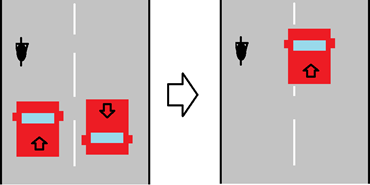
2) Don’t ride in the gutter.  If you do, motorists will treat you like you belong in the gutter.  Most gutter-cycling is a response to the fear of being hit from behind.  In practice this is extremely rare.  When cycling in the gutter motorists will try to squeeze through a gap about as wide as you plus the car plus 5 cm.  These small but apparently passable gaps come up fairly frequently, and being hit whilst being unsafely overtaken is a fairly common form of motorist negligence.  Try to ride at least a metre out from the kerb.  You can start small and slowly increase the distance when your confidence grows.  This will stop unsafe overtaking because there will be fewer opportunities for motorists to overtake when it is not safe to do so.  There is an interesting psychological effect which comes with this technique; motorists are much more likely to overtake using the proper technique prescribed by rule 163 of the highway code:

rule163[1]

To further decrease your risk of being unsafely overtaken,  be sure to not wear a helmet.

gutter 2

This is a common occurrence when gutter-riding, the near-death overtake.
gutter 1

By taking control of your part of the lane, you can prevent this kind of behaviour.

It is also useful to stay at least a meter or so out from parked cars, due to the risk of “dooring.”  It is a sad state of affairs that a great deal of the existing cycle lanes in the UK are placed in the door-zone of parking bays.

3) Look behind you, a lot.  It is important that if you are going to be a part of the traffic, you need to know when is coming from behind.  I tend to check behind whenever I can hear a car approach, except in slow moving “rush” hour traffic where it is not feasible and the cars are not moving fast anyway.  Even when you can’t hear anything it is worth checking behind once a minute or less.  The benefits of doing this are threefold; You know what is coming from behind you, making you more confident to ride further from the left, secondly the person in the car sees you look at them, you cease to be a bicycle in their mind and become a person and thirdly motorists are told during their “training” that they should look out for cyclists who are looking behind them as they may be wishing to pull out shortly.  This helps in making sure you are overtaken safely.

4) Traffic islands and other narrowing road sections.  When the road ahead of you does not allow adequate space for anyone to overtake you, ride in the centre of the lane to stop them trying.  Don’t feel bad about adding 10 seconds onto someone else’s journey in the interests of safety.  Remember you have as much right to the road as anyone else.

5) Right Turns (or left in most of the rest of the world).  Right turns can be problematic when you are being overtaken by a heavy traffic stream.  The key is signal that you want to make a right turn.  Sadly most motorists will ignore their obligation to let you merge, the key is to make it look like you are going to turn anyway, whilst being aware that most motorists will still happily overtake you.  A bit of a scare will make one of the overtaking cars slow down enough to make a merge and then right turn feasible.  This takes practice.

6) Just because cycling infrastructure is there doesn’t mean you have to use it.  Some cycling infrastructure is truly awful, and by not using it you are sending a message that this needs to be sorted, or at least that we don’t want any more crap infrastructure.

7) Roundabouts.  These can be a problem for cyclists, as can the infrastructure designed to provide an alternative for cyclists due to they sheer impracticality of it.  Many busy roundabouts are being replaced with traffic lights, I would like to hope that cyclists’ needs played a part in this decision to move away from them.  They probably didn’t though.  Most people, regardless of conveyance are bad at using roundabouts.  The skills of not gutter riding and looking behind frequently will help on roundabouts, as will being able to accelerate and ride quite fast.  The alternative is to dismount and cross it as a pedestrian.

These are just some of the tips and techniques I use to make the best out of a bad situation.  If you have any more to share please feel free to comment.

Friday, 16 July 2010

Display Fail

IMAG0190

Spotted in Debenhams.  The bike is used to promote some beachy summery clothing.  They don’t actually sell the bike, which is probably for the best considering the rookie fork mistake.  Interestingly the mudguard is on the right way around, although it could do with a bit of anticlockwise rotation.  I saw a similar “fork malfunction” on the Sowerby Bridge to Manchester ride.  I wonder how it handles…

Death of a Seat-Post Binder

On Wednesday I was out on the Yuba Mundo “foraging” for supplies at a distant ASDA (Trafford Park again).  The seat post on the Yuba has always had a tendency to slide down slowly with use, so that it needs adjusting every few rides.  This was more of a problem with the stock 30 mm post & 0.9 mm shim stock configuration than it is with the new Yuba 31.8 mm micro-adjust post.  It does still happen though, possibly due to a slightly excessive application of lithium grease to prevent the post sticking in the frame when the bike was being assembled at Practical Cycles.  I have been worried that I will round off the Allen head whilst I am out in the middle of nowhere, but instead I managed to strip the threads out of the binder, roughly 10 km from home.  Luckily the Mundo is the bike which just keeps on giving, I was able to sit on the rack and ride the bike home chopper-style (but quite slowly).

IMAG0198

Looking at the bolt, I at first thought that was where the stripping occurred.  On closer examination I realised that the bolt was fine:

IMAG0199

I pulled those twisty metal bits out of the bold threads and realised they were from the binder itself.  I have ordered a new 34.9 mm quick-release binder so this shouldn’t be a problem in future.  Sadly this leaves me Mundo-less for a few days.  The moral of the story, Yuba Mundo owners, maybe its worth getting a spare 34.9 mm seatpost binder before  the stock one breaks on you when you are far from home.

Monday, 12 July 2010

HGV “safety”

new-tfl-poster-of-hgv-blind-spot

I just found out about the new Transport for London poster warning cyclists about the dangers or left turning HGVs over at the Crap Waltham Forest blog.  While I am not against teaching people whereabouts on the road they should avoid in order to not become a victim of negligent HGV operation per se it does appear to be more of the symptom-treating approach which we are all familiar with.  If not crushing someone to death in a dense urban area is hard for a lorry driver to do, maybe TFL would be better considering restricting the times of day these vehicles can enter the centre of London so that they pose a risk to fewer people.   Once again part of the problem is badly thought-out infrastructure which encourages people to get into bad positions at junctions:

parody

Thursday, 8 July 2010

Road “Safety”

“Many people are unaware that the number of fatalities amongst young people caused by road accidents is higher than deaths from other external causes, including those that receive much more publicity from the media. In 2008, 73 children aged 0 - 11 years were killed on Britain's roads. Another 1,436 were seriously injured. There is a need for all those involved with children to teach clear road safety messages effectively and consistently, working together to help children understand and manage risk.”

Sounds like the sort of crap you’d expect from the AA or RAC or some other motorist lobby, doesn’t it?  Its actually taken from The Department for Transport’s guidance to teachers.  I’m not trying to argue that children should not be taught how to be safe when crossing the road, merely that it is completely missing the point.  The risk is that by extension you absolve the person actually causing the harm, the motorist of their responsibility by placing the idea that it is up to the victim to prevent becoming a victim.

“Be seen at all times, wear bright clothing when during the day & encourage the use of florescent clothing in poor lighting conditions - armbands or reflective strips on school bags.”

This was taken from the Glasgow Council website.

Walking_Bus_(16)_1[1]

This is the Walking Bus (image taken from site) in the London Borough of Havering.  In order to maintain the prioritising of traffic speed above all else, and to free road users from nuisances like having to take care when driving the council (and many others) have started pushing the idea that this is what kids need in order to safely walk to school.  Surely it would be healthier to look at the cause of their desire to do this rather than merely treat the symptoms?

The problem with this kind of thing is that eventually the news reports change.  Where once you would have read something like this; “The child was crossing the road outside his primary school when he was hit by a Land Rover Discovery,” to this, “The child, who was dressed in dark clothing, was crossing the road outside his primary school when he was hit by a Land Rover Discovery.”  It is a small change but it is placing some of the blame onto the victim (or his parents) for not “being visible,” whilst glossing over the fact that the motorist was negligent by driving such a vehicle outside of a primary school in a manner which left them unable to stop the vehicle in an appropriate amount of time.  Soon maybe half of the kids are dressed up like Christmas trees, they are easier to see from the windscreen perspective and so the average traffic speed increases because the motorists are safe in the knowledge that the kids are easier to see, (so less care needs to be taken) and the kids without the Christmas tree outfit are practically asking to be run over, so they are at least partially responsible, right? 

This is a dangerous way to think, and it has already happened to cyclists with respect to helmets, and partially with respect to bright/fluorescent clothing.  The media will now use the phrase, “who was not wearing a helmet,” quite happily in a report about a cyclist who was clearly the victim of motorist negligence and nothing else.  This perpetuates the myth that the cyclist is partially responsible for the incident by choosing not to wear a helmet (even though it wouldn’t have helped in the slightest) and facilitates further dangerous and negligent behaviour by motorists by suggesting that they are less responsible for the safety of those they may kill with their vehicle.

If you are still not persuaded, compare the pushing of bicycle helmets and high visibility clothing for pedestrians and cyclists to solve the problem of road safety to a problem which kills far fewer in the UK but receives far more media coverage and Police resources; knife crime.  Lets take the Road Safety approach to knife crime; firstly we need knife awareness training in primary schools so that the kids can learn to avoid those areas where knife crime exists.  This could be backed up with a poster campaign or a post-watershed advert series aimed at adults, raining awareness of knife crime and where not to go to avoid being stabbed.  The bad areas where knife crime is rife continue to grow, so the campaign starts to push the idea of stab-vests for all.  Perhaps a catchy “Don’t forget your stab-vest,” advert campaign showing a typical suburban family.  Eventually enough time passes so that when someone without a stab-vest is stabbed to death the phrase, “who was not wearing a stab vest,” would appear in the news stories and the myth that the victim is at least partially responsible for being stabbed for not taking the prescribed precautions begins to gain traction.  Luckily this isn’t the case (yet) although to make the analogy more comparable to the helmet debacle I suppose the stab-vest should be substituted for a set of special magical underpants or something else which would provide no protection in the event of being stabbed.

Cycletraining[1]

This is taken from Wigan Council’s website today.  If we keep attacking our social problems like this then maybe we’ll be seeing this tomorrow:

children%27s%20bulletproof%20vest%20campaign[1]

Taken from here.  No its a real thing.  I really think it should also be high-visibility too, and that kippah doesn’t look like it’ll protect his head much when he inevitably gets hit by a motorist.

Tuesday, 6 July 2010

Crap Cycling & Walking in Manchester #2

Don’t worry, I’m not planning on turning this blog into a Manchester version of the Crap Waltham Forest blog, but yesterday after posting about it I had to walk from work to the city centre (a grand total of about 3 km) and I decided to see how many illegal or inconsiderate things I saw along the way affecting either cyclists, pedestrians or both.  Anyone who reads the Grauniad’s Bike Blog (or any article in the Daily Fail mentioning cyclists) will recognise the phrase “lawless cyclists” from the comments section as it is trolled by non-cycling motorists and the like, so I decided to focus largely on that much more harmful and prolific group; lawless motorists

IMAG0144

Footway Obstruction (sucks to be blind).

IMAG0146

IMAG0147

Gone through red, ASL and cycle lane obstructed.  I saw this happen after the light turned red.

IMAG0149

Convenient seating provided outside the BBC building.

IMAG0151

Walking obstruction, illegal parking.  Guy is asleep in car with engine running.

IMAG0153

More pavement parking outside EastZEast restaurant.

IMAG0152

This guy chose to blow through the red and through most of the ASL too.

IMAG0154IMAG0155

Another person parked across the footway at a side-road.

IMAG0156

More ASL abuse.

IMAG0157

Contractor has abandoned a road sign on the pavement on Princess Street.

 IMAG0158

Pavement and double yellow line parking on Princess Street

IMAG0159

Footpath commandeered by business for advertising.

IMAG0162

Illegal and inconsiderate motor-scooter parking.

IMAG0163

Parked on double yellows and pavement.

IMAG0164

And again, the same pavement and double yellow line parking.

The purpose of this walk into town was to meet someone for a lift.  As I arrived in town I realised that this would be the first time I had travelled in a car in about 3 months.  I decided to note my outsider perspectives of car travel during the journey.

Firstly, I felt extremely low down whilst going along the road, which made me feel less safe than when on a bike.  I also didn’t like how the car itself severely restricted my view, especially to the sides and rear of me.  I also noticed how many people would change lane without any indication, but other drivers seemed ok with this.  I don’t imagine being so happily accommodated on a bike, or motorcycle.  All these things made me feel less safe than when on a bike, but  the caged-off nature of being in a car and the fact that I only had a windscreen view of the world around me made me feel a lot more detached from the danger around me, as if I was watching TV or playing a video game.  I think the people who don’t cycle because they feel it is dangerous only feel that way because they are used to driving, and that their safety concerns are largely subjective.  I felt a lot less safe in the car than I do on my bike and I think next time I will take the bike.

Monday, 5 July 2010

Crap Cycling & Walking in Manchester

I have recently been reading the blog Crap Cycling & Walking in Waltham Forest, now on my blogroll.  It has made me realise how much I have been conditioned to accept the relentless prioritising of motorised traffic and traffic flow above all else, even human life.  I am beginning to see how often I am marginalised and inconvenienced by this both on and off the bike everyday.  In honour of this eye-opening blog, and for your enjoyment I have decided to photograph some inconsiderate road users:

IMAG0135

Inconsiderate and illegal parking on double yellow lines and over dropped kerb on Ackers Street, next to the Stopford Building of the University of Manchester.

 IMAG0143 

Inconsiderate and illegal parking of a motorised scooter on the pavement in the bike parking facilities at Spinningfields, off of Deansgate.

IMAG0142

Yet more inconsiderate and illegal motorcycle parking in the same bike parking facilities.

IMAG0085

And finally yet more of the same, this time at the oddly placed bike parking facilities outside of Manchester Metropolitan University’s Aytoun Street building.  I also saw, but did not have chance to photograph a police car doing an illegal left turn at the end of Aytoun Street onto Portland Street, blowing through a pedestrian crossing on green.  Inspiring behaviour from those who are meant to protect us from being killed by others doing such manoeuvres.