This blog has moved

This blog has re-located to Chester

Showing posts with label Utility Cycling. Show all posts

Monday, 30 January 2012

Manchester Cycling Strategy

The Interim Strategy for Cycling in Manchester (draft) was recently brought to my attention via the GMCC. The draft can be found here (Hat tip: Manchester FOE). The Manchester Cycling Strategy (MCS) is a result of the Memorandum of Understanding between British Cycling and Manchester City Council. The executive summary on page 4 states,  "Manchester is the home of British Cycling - cycling's national governing body." Whilst it is true that British Cycling is the governing body of cyclesport, the relevance of British Cycling to transport cycling is at best, dubious. Whilst British Cycling have recently started to devote some attention to cycling as transport, they are first and foremost the governing body of cyclesport and not an organisation for furthering the aims of everyday folk who want to use a bike for transport.


The biggest problems in the MCS draft are often a result of this confusing mixture of sports promotion and facilitating cycling as transport. A good example to illustrate the absurdity of this is to consider motorsport. Whilst I am sure that there are a good number of people in Greater Manchester who participate in the various disciplines of motorsports, from rallying to formula three, the groups which represent these interests rarely weigh in on transport consultations such as the LTP3. Where they do decide to comment, it is extremely unlikely that they would try to present themselves as the 'voice of the motorist' because clearly they aren't - they are the voice of motorsports. Whilst these two groups are superficially similar, their interests, needs and wishes are (quite rightly) lobbied for by separate groups. 


In cycling, the distinction is less commonly made, perhaps because there are so few people who regularly use bicycles for any purpose. The problem with this is that cycling is conflated with cyclesport, giving cyclesport a louder voice than it perhaps deserves, whilst making cycling for transport less visible and less attractive to normal people who aren't interested in getting hot and sweaty in order to go shopping or to work.


This conflation of cycle sport with cycling for transport is illustrated well on page 5 which includes a list of headline figures for investment in 'cycling' over the past five years:


  • Over £3.2 million on infrastructure through LTP Highways Capital Programme
  • £518,000 on child cycle training
  • £56,000 promoting bike week
  • £24 million building the National Indoor BMX area
  • Over £12,000 in small grants to community groups
  • £2.5 million on promoting and supporting club and sport cycling
  • Over £250,000 on promoting cycling through initiatives such as Sky Rid [sic]
From this list, several issues stand out to me.
  1. Is all of this funding coming out of a single pot for 'cycling?'
  2. What does the National Indoor BMX Arena, supporting club and sport cycling and to a certain extent, the Sky Ride, have to do with cycling for transport?
  3. If (1.) is in fact the case, how can £24 million for the National Indoor BMX Arena and £2.5 million on promoting club and sport cycling be justified when only £3.2 million is spent on cycle infrastructure for transport cycling, which has the highest potential for growth and thus has easily the highest potential economic, social and public heath returns.
  4. The cyclesport-oriented aspects of this report should be part of a wider report on the uptake, promotion and enabling of sports in Manchester (which in itself is an important and laudable aim)
  5. The cycling for transport-oriented aspects of this report should be part of Manchester's wider transport strategy (and dramatically increased in their scope)
Where the report discusses strategies for increasing and improving cycling in Manchester it refers to the LTP3 plan mentioned previously. The LTP3 is worded in a way which allows for the construction of a real network of quality cycle corridors to Dutch standards, the result of which would be immense growth in transport cycling in Manchester and the enormous wider benefits that brings. Unfortunately, it is also vague enough to allow for little change from the status quo, beyond a bit of paint and some crap signage along back-streets; the sort of measures which have already been well-established to be ineffective. The strategy goes on to identify five 'key issues' holding back transport cycling in Manchester:
  • Addressing the demand for cycle parking
  • Making major junctions safer for cyclists
  • Working with partners to reduce cycle theft
  • Liaising with City Centre employers to improve workplace cycle parking and changing facilities
  • Improving opportunities to cross the inner ring road
Sadly, these issues are more likely 'things which existing cyclists would like fixed' rather than issues which hold back those who wish to cycle for transport but do not currently do so. These issues are likely to be along the lines of:
  • Fear of being killed or injured when cycling with motor traffic
  • Separated bicycle tracks on main roads
  • Junction designs put cyclists (and pedestrians) in unnecessary danger in order to prioritise private motor traffic
  • Rat-running makes riding on streets feel unsafe
All of these issues are tackled in The Netherlands road network model; busy main routes have separate tracks and motor-vehicle rat-running (and hence volume) is eliminated on streets where people live (making them attractive for cycling despite the lack of separation). Address these issues (even in the form of a barebones functional network) and cycling rates in Manchester could easily be increased to 10-15 times their current level. 

Despite the paramount importance of infrastructure in making cycling into a viable mode of transport for normal people, the only infrastructure mentioned in the MCS draft are the three cycle centres to be built in the city centre. These will only improve the experience for existing cyclists, they will provide little or no benefit for would-be cyclists. My mother doesn't ride a bike, not because there is nowhere for her to park her bike, shower and stash her lycras in a locker. She doesn't cycle because she (entirely understandably) feels unsafe when cycling on our roads as they currently exist. Providing facilities which would be unnecessary in a mainstream cycling culture is not the way to build a mainstream cycling culture. Where cycling for transport is mainstream, people ride in whatever clothing they need to be wearing at their destination (possibly in addition to a coat and gloves) with the idea of needing to shower and change after cycling to work being something which is utterly irrelevant in a mass cycling culture.

The MCS at least does not explicitly exclude measures which would actually allow cycling for transport to grow, but unfortunately it takes the traditional approach of 'tinkering around the edges,' focussing on marginal improvements for existing cyclists whilst completely ignoring the reasons why normal people would never consider cycling for transport. In addition to the desperate need for vastly increasing the scope of the measures proposed to increase cycling for transport, the inclusion of so much irrelevant material pertaining to cyclesport confuses the issues for all users of cycles. Ideally, the cyclesport content in the MCS should exist as a part of a wider 'Sport in Manchester' strategy in order to prevent the needs of those participating in these two largely unrelated activities being confused. The report also focusses on leisure cycling separately. It is my belief that leisure cycling does not require a huge amount of specific 'strategy' to grow, provided that cycles are considered during the design or renovation of parks & towpaths etc. The measures which will make cycling for transport attractive to normal people will also increase the appeal of cycling for leisure.

Wednesday, 26 October 2011

Light is Running Out

It's that time of year again. When Sunday comes it will be dark a lot of the time for anyone who works a conventional 9-5 shift pattern. This will be my second winter of riding with dynamo lights, with dynamos on all of the bikes this time, although still only enough lights for two of them; the Brompton and the DL-1. This is the perfect time of year to 'go dynamo,' not only for the long-term savings but, as I learned myself last winter, it's extremely liberating.

Some people hang up their bikes for winter. If you are a utility cyclist however, this is unlikely to be the case. I have ridden through every winter since I started cycling again as an adult. However, until last year I never really got any enjoyment doing it.  Having to remember to take my lights everywhere, carry them around when off the bike was a minor hassle. What really bothered me was the persistent, nagging concern that I'd be caught out by flat batteries and have to risk a ride home without lights. The battery lights I had used in the past were adequate, but never truly that bright. I knew of the much brighter options available but the price never seemed justifiable to me, for something which could so easily become useless if forgotten of accidentally uncharged.

When I bought my first dynamo lamp, a B&M Lumotec Retro N senseo plus, it was mainly because I was concerned with having a light which was in-keeping with the aesthetics of my then new-to-me DL-1. English-language information regarding dynamo lights was pretty sketchy, I wasn't sure what I was going to get. Because of this, I was pleasantly surprised to find that the light I had purchased was actually a lot brighter than my previous battery-powered LED lights, despite being a halogen bulb. It was always there when I needed it and would even come on automatically when darkness fell. This started to change the way I felt about riding in the dark, from something to be avoided to something to relish. As that first dynamo winter drew in, I found myself riding as much as I had during summer. 


Naturally, I had to get the rear light powered by the dynamo too, whilst permanently attached to the bike, the rear the battery light which came with the DL-1 was still a weak link, dependent on batteries. Once again, information was lacking. B&M produced rear lights with the same automatic light-sensor on/off control as the Retro, although it seemed that this feature was only available with the battery or battery/dynamo hybrid models. Once again I took the plunge and purchased a B&M D-Toplight Plus. The tail-light was wired into the connectors on the front lamp for this purpose; to my surprise the automatic light sensor in the front light also controlled the power supply to the rear light. When it got dark both lights would come on automatically (including when passing through a tunnel). Brilliant.


Having this kind of set-up on the DL-1 made the Yuba Mundo seem almost a hassle to ride. The Shimano dynamo hubs available in my price range were all intended for use with Centerlock disk brakes, rather than the standard 6-bold arrangement used on the Yuba Mundo. The additional cost of a new Centerlock rotor or an IS adaptor pushed the price to more than I could justify spending at the time. A post from Lovely Bicycle! gave me the answer I was looking for, a bottle dynamo. Older bottle dynamos (and modern cheap ones) have contributed to the poor regard with which dynamo systems are viewed here in the UK. However, higher-spec bottles such as the Nordlicht 2000 or the B&M Dymotec seemed to offer a reasonable trade-off between performance and price. I decided to opt for the Basil Nordlicht bottle dynamo in combination with with a B&M Lumotec Lyt plus, a reasonably priced light with a higher light output rating than the Retro. Due to budgetary constraints, an additional rear light would have to wait.


Unlike the Sturmey Archer X-FDD hub dynamo on the DL-1, the Basil Nordlicht took a bit more work to find the optimum fitting. The advantage of the Basil Nordlicht is that the rollers can be changed. Multiple variants are available including a steel roller for running on the tyre, a rubber roller for running on the rim and a larger rubber roller for running on the rim at higher speeds. The larger roller is particularly useful as it allows the dynamo to be 'geared down.' As bottle dynamos are typically designed to produce full power output at relatively low speeds (<10km/h) they can produce too much drag when used by faster cyclists. The larger roller compensates for this by reducing the amount of dynamo revolutions per tyre revolution, and hence the resulting drag. Initially the bottle dynamo was mounted on the fork, unfortunately the pressure it exerted on the rim caused the rotor of the disk brake to rub against the brake pads when it was engaged. Eventually I mounted the dynamo on the seat-stay and adjusted the mounting angle which produced ideal dynamo contact pressure on the rim, enough to prevent slippage but not enough to create noticeable drag.

At present the Basil Nordlicht bottle dynamo is still fitted to the Yuba Mundo, although there are no dynamo lights fitted for it to drive. This is due to my acquisition of a Brompton. After a few weeks with the Brompton, I felt that a bike such as this really needed to be all in-one, including self-sufficient lighting. It was around this time that the annual price increases for Brompton components were being rolled out. The Brompton dynamo wheel RRP was about to increase by about 15% making that then the ideal time to upgrade to the Shimano hub dynamo wheel. I had considered the fitting the Basil Nordlicht bottle to the Brompton, but the relatively good price of the wheel and my uncertainty about clearances for fitting the bottle led me to choose the hub over the bottle.


Rather than splash out on a new front light, my limited budget led me to fit the Lyt from the Yuba Mundo instead. My intention was to replace the front lamp on the Yuba Mundo at a later date, which I have still yet to do. Initially I bent the Lyt mount to fit it into the tight space between the caliper brake and the luggage block, a solution which was far from ideal. I was later able to use a Brompton Cyo mounting bracket to fit the Lyt into the limited space offered by the Brompton. I also added a Brompton rear dynamo light (made by Spanninga) to complete the set-up


The version of the Lyt I had purchased for the Yuba Mundo was the bottle dynamo version; when connected to the hub dynamo on the Brompton, both front and rear lights ran whenever the bike was in motion. Whilst not as optimal as the automatic on/off light sensor of the Retro, this set-up actually works well, due to the extraordinary operational lifespan of LEDs. It now appears that I was a little ahead of the curve in choosing this set-up; B&M's entire 2012 range of dynamo lighting comes with the option for daylight running lights.

My experiences with dynamo lighting have not been universally positive. The standlight functions on both of the lights fitted to the Brompton failed by summer, although they were both relatively easy to fix. However, it is my 'off-label' riding with the Brompton which is more likely the cause of this failure than any deficiency in the lights' designs; Bromptons are not really ideal bikes for fast riding on cobbled paths, the resulting vibrations were obviously a bit too much for the capacitors powering the standlight. Under more typical riding conditions I doubt that this problem would have occurred. For this reason I would still strongly recommend dynamo lighting to anyone, including the models of light which I have had problems with.

A great deal of dynamo lighting technology is designed by (or for) the German market. German regulations stipulate that a bicycle must be sold complete with a dynamo lighting system (except lightweight sports-bikes), including lights which conform to specific regulations for beam shape and light intensity. These regulations are more strict than elsewhere and have effectively become the de facto international standard. The misconceptions about dynamo lighting which persist in the English-speaking world means that we do not constitute a huge proportion of the market for dynamo lighting components, with equipment and information  often difficult to come by. B&M in particular make great equipment but the English-language information about them is lacking. They also suffer from the Windows Vista effect; huge numbers of variants on each light model exist with relatively subtle differences between them and confusing nomenclature. These differences are seldom well explained in product descriptions on the handful of retailers which stock them.

Because of this, to help prospective dynamo light users I have produced a B&M dynamo light nomenclature guide:

Lumotec: The front dynamo light brand name.
Toplight: The rear dynamo light brand name.
Retro, Lyt, IQ Fly, IQ Cyo etc: The model name.
Plus: Includes standlight. The light (or a portion of it) remains illuminated for a few minutes after motion stops.
Senseo: Includes automatic on/off via light sensor.
N: Includes an on/off switch, intended for use with hub dynamos.
B: Basic version, lower light output but still meeting German minimum standard.
R: Taller beam, including near-field illumination of dark patch in front of wheel.
T: Daylight running lights. In addition to the beam aimed at the road, a series of small LEDs direct light at oncoming traffic to increase cyclist visibility. During the day these lights remain lit, whilst the main beam runs at reduced power or is switched off.


B&M are of course not the only manufacturer of dynamo lights, merely the one with which I have most experience. Mr Hembrow gives high praise to the new dynamo front lamp manufactured by Philips; the Saferide (repeated elsewhere). It is my hope to test out a Saferide in the future and share my impressions here. If anyone has any questions about 'going dynamo,' please feel free to leave a comment and I will endeavour to help you if I can.

Wednesday, 22 June 2011

DL-1: One Year On

CIMG2673


It has been around a year since I took delivery of my Raleigh Tourist De Luxe. Of course by, "Took delivery," I mean cycled to Didsbury on the Yuba Mundo to meet the old gentleman from whom I was purchasing this fine steed, and towed it back to home. At first I wasn't sure if it would be for me, having had no opportunity to test ride it. What I did know however, was that if I didn't like it, I could sell the bike (or its component parts) for a fair bit more than I paid for it that day.

When I got the bike home, I adjusted the saddle and took it for a spin. Whilst I liked the ride, it wasn't quite right; the gearing was far, far too high, with first gear being what I imagine a reasonable third gear should feel like on a three speed. The rod-brake handlebar was limited in its range of height adjustment and the angle of the bar was fixed. Luckily, a few replacement parts allowed me to fix these minor gripes and turn the bike into the perfect everyday transport solution for me. Over the past year I have made numerous additions and upgrades to the bike.

Additions and upgrades:
I have also been forced to replace a few parts due to failure.

Replacements due to failure:
However, I should mention that the X-RD3 hub was at least somewhat faulty from the start, and that my own experience shouldn't detract from the consensus that this hub, and internal hub gears in general, are the best choice for a practical, low maintenance utilitarian bike.
After a year riding this bicycle, I can sincerely declare it to be one of the smartest purchases I have ever made. Since getting this bike I certainly cycle a lot more. My odometer is currently displaying a total distance cycled of 13,029 km, up from 8,000 km at about this time last year, most of that distance has been for transportation (as opposed to leisure), covered on the DL-1 because it is such an easy bike to ride.

When I say the DL-1 is easy to ride, I am not just referring to its ride quality (which is excellent). As an upright bike with mudguards, a chain-case, comfortable Brooks saddle and (since the addition of the saddlebag) permanent luggage, puncture-resistant tyres, automatic & permanently affixed dynamo lighting and low maintenance brakes and gears, all I ever have to do if I want to go out is unlock the bike, hop on and go. It is my hope that all of these features represent part of a bigger future for cycling in the UK, even if a lot of them come from its past.

CIMG2674

The Tourist De Luxe as it is kitted out today

Whilst not quite the same as my Tourist De Luxe, Raleigh has recently started to sell the Raleigh Superbe again in the UK, after courting the, “Sporting goods,” and “Bicycle-shaped object,” markets almost exclusively here for the past few decades:


The 2011 Raleigh Superbe, is specced and priced similarly to the Pashley Roadster Sovereign (although not made here in the UK). It is available from numerous cycle outlets, including Evans Cycles.

Tuesday, 21 June 2011

Running and walking

I have a few friends who are enthusiastic runners. Personally I don't see the appeal, I understand the health benefits and even the potential to feel a sense of achievement after running a certain distance or doing so faster than a rival, but it really isn't for me.

However, what I find most peculiar about running is that it usually completely absent from transport consultations such as the Greater Manchester LTP3. There was no mention of any athletics facilities at all in the LTP3, and United Kingdom Athletics did not submit a response at all. Whilst it could be argued that running is a sports or leisure pursuit, it is in many respects similar to walking, which is considered by this kind of consultation to be (an admittedly unimportant) form of transport.


The title page from the LTP3  "Active travel" section, with a picture choice which aptly shows everything which is wrong with cycle promotion and provision in the UK.

Of course it doesn't make sense to talk about running in the same terms as we talk about walking. Running is a popular leisure pursuit, but it is not the same as walking. Whilst some also walk for leisure or health, it is primarily considered to be a simple and effective way to get from A to B. When government talks of, "Providing for pedestrians," they generally do not mean providing showers at work for those whose commute is a run, providing pleasant cross-country running routes or shiny new athletic facilities.

When government talks of, "Providing for cyclists," however, they confuse cycle-sport and leisure cycling with cycling to get from A to B, an error akin to confusing runners with pedestrians. Whilst there will always be a minority of sporty cyclists who use their time travelling to work as a training ride, just as there are a few people at my place of work who use their time travelling to work as a training run, complete with performance clothing and a shower afterwards, this is not and never will be a mainstream activity. There's nothing at all wrong with treating your ride to work as a training ride, but by confusing a minority pursuit such as this with utility cycling, which when provided for adequately, can be a mainstream mode of transport, successive governments (and some cycle campaigners) have failed to achieve any significant, meaningful gains in cycling rates. Promoting running and providing a circuitous cross-country route is not going to persuade the overwhelming majority of motorists to switch away from driving the 2 miles to work. Providing a decent walking environment and promoting walking (whilst hindering motoring) is. The same applies to cycling. 

Cycle sport is probably very nearly as popular as it is going to get, and the popularity of this hobby is particularly impressive. Utility cycling by non-enthusiasts has been suppressed by years of car-centric and outright hostile street design to a level similar to that of sport-cycling, making it easy for governments and even cycling campaigns to consider cyclists as a single homogenous group. This confusion of sport cycling with the much greater potential for growth in utility cycling from A to B severely limits the potential for cycling's growth. If we want to see any significant gains in cycling rates, we need to end this confusion of the more-nichey sport-cycling with the kind of everyday, utility cycling which can be made to appeal to the average person where the right kind of provision is made for them.

Saturday, 30 April 2011

Yuba Running Boards

IMAG0836

I’ve finally got around to installing a running board on the Yuba Mundo. Yuba sells their own plastic versions of these for each side of the bike, but they rely on the treaded bosses which are only present on the V3 frame. My running board was made with plywood using only a jigsaw, and attached to the bike using cheap hose clamps. Getting the shape right was as simple as holding the plywood board in place and drawing the outline of the rail onto it with a pencil. So far I have only added one running board so that I can still tow a 26 inch/700C etc wheeled bike easily if needed.

IMAG0833

The board stops the Brompton from falling through the gap in the side-rail, meaning it can be carried lower down on the side rather than bungeed to the top. This lowers the load and means the Yuba handles brilliantly whilst carrying the folder.

IMAG0834

IMAG0827

It is almost as if they were made for each other.

Thursday, 14 April 2011

Ride Report: Bakfiets

This is my last ride report from my trip to Practical Cycles, where I was able to try out several cargo bikes I had never ridden before. I decided to save the best for last, the Bakfiets.nl Bakfiets. This particular Bakfiets’ frame and box is also used as the basis for the Workcycles Bakfiets as seen on iamnotacyclist.

CIMG2514

The model I tested had the rain-cover add-on attached. Designed to keep your cargo (be that animal, vegetable or mineral) dry, the rain cover does not impair the rider’s view or negatively impact the ride.

CIMG2515

The seat-tube angle is very low, even by the standards of Dutch geometry. This allows the rider to fully put a foot or two down whilst stationary, which helps to balance larger loads, or loads which move themselves around. The slack seat-tube angle means that despite being able to put your feet down when stopped, it is possible to get a good amount of leg extension whilst cycling, allowing the rider to put a good amount of power down. It is nice to see this level of though devoted to frame geometry after seeing so many bikes where geometry seems to be an after-thought (I’m looking at you “hybrids.”)

CIMG2512

Looking through the plastic rain-cover which forms a tent over the cargo box. 5 year old me would have loved riding in there, and I would probably still be partial to doing so. Seat platforms with seatbelts are available for seating up to four children, in up to two rows of two. Alternatively, the box can be emptied of these to fit in an adult, dogs or non-live cargo.

CIMG2516

The Selle Royal saddle is likely aimed at novice or non-cyclists. I found it acceptable for my short test ride, but I expect experienced cyclists would replace this with a Brooks B67 or similar.

The choice of componentry is ideal for this kind of bike, it is low maintenance, durable and weather-proof:

CIMG2511

The Bakfiets is fitted with durable Schwalbe Marathon tyres front (406 mm, 20 inch) and rear (559 mm, 26 inch)

CIMG2501

Shimano Nexus 8-speed internal hub gears, and a Shimano roller brake. An upgrade to the much more powerful IM70s is available

CIMG2507

A full chain-case is provided to protect the rider from the chain, and the chain from road filth

CIMG2508

The front hub is a Shimano dynamo hub, and the brake is a Shimano roller, again upgradeable to the IM70

CIMG2510

Dynamo-powered  Basta Pilot front lamp with automatic light-sensor switch

CIMG2503

Battery-operated rear light attached to the rear rack, further expanding the load capacity

CIMG2502

Frame fitted rear-wheel O-lock and dressguard

CIMG2506

The steering linkages which run under the box allowing the rider to turn the front wheel with the handlebars as normal

CIMG2515

The bakfiets also has a very wide and sturdy kickstand which clips to the underside of the box when not in use

It took me less than a minute to get used to the altered handling caused by the  front wheel offset, mainly because the offset of fairly minimal when compared to a normal bike such as a roadster. The handlebar is attached to a very steep tube, and the front wheel is only 20 inches in diameter to accommodate the box. This results in a stet up where the front wheel is only slightly more further forward than that of a 28 inch wheeled roadster with a slack headtube angle, such as the DL-1 or a Pashley Roadster/Princess.

The bike feels a lot lighter to ride than I expected, and easier to manoeuvre through doorways and such when not being ridden. The gearing offered a suitable range of low gears for accelerating & hill climbing with loads, with a good enough range to allow you to reach a good speed. The extended wheelbase produces a very stable and enjoyable ride, which despite the notable differences in design, feels instantly familiar to me as a Yuba Mundo owner. The ability to put your feet down whilst still having adequate leg extension makes the bike ideal for carrying children, where the desire to keep the bike upright when stationary needs to be balanced with being able to effectively propel the extra mass along.

The bakfiets is an extremely versatile bike, capable of hauling loads of cargo like the longtail Yuba Mundo or Surly Big Dummy, but with the re-assurance of having that cargo visible to you whilst riding. This is especially important for carrying passengers as it means parents can keep a watchful eye on their children, or adult passengers can more easily socialise with their chauffeur than on a longtail bike. The bakfiets also opens up possibilities for animal carrying which is less feasible on other cargo bikes, such as a larger family dog. When I have the space and money, I will definitely be getting one of these.

The Chorlton Green Festival is on Saturday, and the bakfiets along with the Surly Big Dummy, Yuba Mundo, BSP Seine, Circe Helios, Nihola Cigar Trike will be there at the Practical Cycles stall for test rides, along with the Zigo Child Stroller/Trike and the Civia Loring Town Bike. See you there.

Wednesday, 13 April 2011

Ride Report: BSP Seine “Motherbike”

During my recent visit to Practical Cycles I was able to test ride a number of bikes including the BSP Seine bike. I will be posting ride report for the Bakfiets later this week. Previous ride reports can be found here.

CIMG2536

The BSP Seine is a modern-styled Dutch bike; it has the geometry and practical componentry of a classic Dutch bike but it is made of oversized aluminium tubing rather than lugged steel. It is aimed at a family audience, having two child seats in addition to a pair of small panniers.

CIMG2538

The smaller of the two child seats is placed up-front, with the handlebar wrapping around the seat.

CIMG2543

The larger child seat is placed above the rear rack, without preventing the use of smaller panniers

CIMG2542

The bike has a very appropriate specification; hub gears (7 speed Nexus) and roller brake in the rear

CIMG2540

Roller brake and dynamo hub in the front

CIMG2539

Smart-brand light-sensing front lamp

CIMG2544

Battery-operated light & motion sensing automatic rear light

CIMG2541

And of course a frame-fitted O-lock and skirt-guard

The bike is also equipped with a full chain-case, mudguards, a steering stabiliser and a twin-leg kickstand. When I came to ride the bike, if felt instantly familiar. The geometry and swept back handlebar gives the bike a similar ride quality to the DL-1. The low step-through meant that the front child seat did not negatively affect getting on or off the bike, and it did not diminish the ride. The handlebar was tilted a bit low for me, but this can be easily adjusted to accommodate a range of rider heights.

The roadster-like handling characteristics make the bike extremely stable, which is ideal for a bike designed to carry children. It is definitely a much better option than carrying your kids the one mile to school in a Land Rover.

Zaynan from Practical Cycles will be at the Chorlton Green Festival on Saturday the 16th of April. Amongst the cycles he will have with him will be the BSP Seine, so head down there if you fancy a closer look or a test ride.

Saturday, 9 April 2011

Ride Report: Nihola Cigar Tricycle

During my recent visit to Practical Cycles I was able to test ride a number of bikes including the Nihola Cigar Trike. I will be posting ride reports for the other bikes I test rode throughout the course of this week and the next.

CIMG2555

The Nihola Cigar has two front wheels, much like a Bakfiets tricycle.

The specification of the bike was generally sensible, dual drum brakes up front, controlled by a single lever (bicycle polo enthusiasts take note), Schwalbe Marathon Plus tyres, a seven speed Shimano Nexus internal hub gear, mudguards, a partial chain guard and even a rear rack to add even more capacity. The trike also includes a parking brake, to prevent it rolling away on uneven ground

CIMG2556

The front wheels have unbranded drum brakes in them, although judging by the hub shells I’d guess they were Sturmey Archers.

CIMG2557

Shinamo Nexus 8-speed internal hub gear. 

CIMG2559

The frame is re-assuringly well built, with the cargo box being well-attached to the frame in numerous places.

CIMG2558

A frame-fitted rear wheel lock is also included to prevent the bike being ridden off whilst the rider nips into a shop.
 
The rear wheel has a V-brake which I find to be a bizarre component choice on a bike such as this, where there is less pressure to keep costs to a bare minimum. A rear roller brake would have made more sense in my opinion, although with dual drum brakes at the front, this is only a small negative.

CIMG2554

Inside the cargo box is a child seat, suitable for two children, complete with seatbelts. The front portion of the box is clear, allowing the passengers to see where it is they are going. The box is capacious enough to allow a decent amount of stuff to be carried in addition to children, and the rear rack adds further capacity.

This was my first “two-front-wheels” tricycle experience, and it has been a very long time since I have ridden any other tricycle, so I was expecting it to feel a bit odd for me. As a non-driving cyclist, I am unaccustomed to having to slow down to take corners. However, after a few minutes I started to get used to the differences between this and a bicycle and I enjoyed  the fact that the tricycle required no balancing on my part whatsoever, meaning that very heavy loads would be more manageable. Overall it was very fun to ride after I'd gotten over the first few hair-raising corners

There were a few downsides to the tricycle, its size means it would require a garage or similar for storage, being wider than the average doorway. A reverse gear would also be a welcome addition for low-speed manoeuvring. Bicycle tyres are parabolic in profile because of the way a bicycle turns. Because trikes are less common, they tend to use bicycle tyres which will wear out more quickly due to the inability to lean in on corners. Square-profile tyres (as seen on cars) would be a good innovation for most tricycles, but in the meantime the super hard-wearing Schwalbe Marathon Plus tyres are a good choice in the specification of this trike. I imagine that not trying to take the corners at full speed as I did will also improve tyre life.

I personally found the urge to lean into the corners to be difficult to overcome, but for someone who also drives and cycles or someone who doesn’t/cannot ride a bike, I can imagine the handling will feel quite normal, and this tricycle could be the right choice for them. The fact that the trike doesn't need to be balanced or propped up when stationary will be a big bonus for those carrying children.

Zaynan from Practical Cycles will be at the Chorlton Green Festival on Saturday the 16th of April. Amongst the cycles he will have with him will be the Nihola Cigar, so head down there if you fancy a closer look or a test ride.

Thursday, 7 April 2011

Yuba Mundo: Version 3

When I bought my V2 Yuba Mundo back in 2009 I was aware that there was a new and improved model in the pipeline. The V3 came out a few months after I got my V2, thankfully at a higher price point which helped to minimise any sense of buyer’s remorse caused by the shiny new model. Whilst at Practical Cycles, I decided to take a few pictures of the V3 Mundo and discuss the improvements made since the V2.

CIMG2532

The V3 Yuba Mundo (Basil Newspaper panniers, Yuba child seat and Bread Platform are not included as standard)

CIMG2534

The frame has been altered slightly, including several new threaded bosses in various positions to facilitate any home-made additions you may wish to use

CIMG2526

The side rails have been redesigned too, attaching to the frame in the manner of a threadless steerer’s stem, as shown the the picture above. In addition to this, they are now constructed from cromoloy steel for added strength/reduced weight. Having occasionally removed the side rails from my V2, I imagine (and hope) that this new system is easier to re-install than the previous design.

CIMG2524

In addition to the threaded bosses, there are strap loops on various parts of the rack to facilitate carrying items using cam straps. A welcome addition.

CIMG2523

The V3 Yuba Mundo fork, now with IS disk brake mounting tab. I came up with my own solution to the absence of this on the V2

The rear OLD has been increased from 130 mm to the more common 135 mm which will simplify upgrades for V3 owners by removing the need to cold-set the frame. In addition to the new front and rear disc brake mounts and the disc brake wheel option now available from Yuba, the wheels have been upgraded to cartridge bearings to decrease maintenance.

Yubatrans3

The transmission has also been upgraded, with Shimano front and rear derailleur gears for a 21 speed stock set-up, versus the 6 speed standard set-up on the V2. Sadly it is still unlikely that Yuba will be offering a hub gear option any time soon, if ever, due to the unusual 14 mm rear drop outs, and the additional costs of hub gearing.

There are numerous other small upgrades to the spec all over the bike; the seat post is now a micro-adjust affair, mudguards are now included in the spec, the stem has been upgraded to an adjustable version and the handlebar grips are higher quality too.

The V3 is a noticeable improvement in spec over the V2, and the frame has a number of improvements too. All this comes at a price however, with the V3 costing more than my V2 (even factoring in two VAT rises and inflation), and the loss of Schwalbe’s excellent Fat Frank tyres as part of the standard spec. Overall the improvements are welcome, making the Yuba Mundo an even more attractive proposition for prospective cargo-bike buyers.

Tuesday, 5 April 2011

Who asks for this crap?

Anyone who cycles in the UK will have encountered our unique cycling infrastructure, which is truly in a class of its own. I, like many other have often wondered who asks for this useless, inconvenient and dangerous infrastructure? How does it come to be?


Warrington Cycle Campaign’s Facility of the Month, January 2011

The answer to this became clear to me whilst I was reviewing the report on the Greater Manchester LTP3, a consultation with the public and relevant organisations on the future of transport in Greater Manchester. These kinds of consultations are relatively common activities run by local authorities all over the UK.

When I was reviewing the LTP3 report, I noticed an interesting disparity between the organisations’ responses and the individuals’ responses. Individuals frequently asked for cycle lanes, but understandably they did not go into detail with respect to design standards of these lanes (except for me in my individual response). Organisations claiming to represent cyclists, such as the CTC and British Cycling asked for things such as 20 mph zones*, workplace showers, cycle parking and cycle training, but not separate infrastructure.
By ignoring cycle infrastructure, or ranking them as the “less preferable” options as the CTC’s Hierarchy of Provision does, councils are left with individual respondents asking for cycle lanes with this request not being mirrored by cyclists’ organisations and no guidance or lobbying on the standards of lanes** forthcoming from these organisations. The DfT does offer some reasonable guidance for cycle facilities, but because historically the national cyclists’ organisations have focussed their energy doggedly on vehicular cycling, these remain advisory and are treated as unattainable ideal standards rather than as the absolute bare minimum.

There is a definite disconnect between cyclists’ organisations such as the CTC and the needs and wishes of everyday cyclists and the millions of potential cyclists, who are put off by having to cycle in close proximity to huge volumes of fast traffic. Individuals continue to ask government for cycle lanes in consultations and cyclists’ organisations continue to ignore the elephant in the room. The result is Facility of the Month.

* 20 mph zones are a great idea in residential and dense urban areas. They are not going to achieve any meaningful rise in cycling alone though. As long at they are surrounded by fast A and B-roads without any separate infrastructure for cyclists, they are little more than isolated islands of safety.
** Hopefully this will change at a national level with the launch of the Cycling Embassy of Great Britain, offering a voice for separate infrastructure, technical guidance and an umbrella for local cycling campaigns whose goals are the same.

Wednesday, 30 March 2011

Ten bike parts & accessories due for a comeback

Progress is generally accepted as a good thing, but sometimes new trends, materials and components come along which don’t have all the advantages of the things they replace. This is especially true in the world of bicycles. I present here my top ten bicycle technologies and accessories which I feel are due for a comeback (some of which are already enjoying a bit of a resurgence).

Hub Gears


The innards of a Sturmey Archer AW hub I am currently working on. Even in this state, the hub is still working.

My first experience of hub gears was in Belgium, on a hire bike used for a bicycle tour of Brussels. The bike was equipped with a Nexus 8-speed hub which offered a similar range to my 24-speed derailleur-geared bike of the time. I instantly appreciated being able to shift gear when stationary, the possibilities for enclosing the chain and the increased durability from sealing away the gears inside the hub.

Two of the Three bikes I now own have hub gears.

Drum/Roller/Coaster Brakes


Image courtesy of Ecovelo

The same bike in Brussels had the most basic model Shimano Roller brakes. These were weaker than the disc brakes I was used to at the time, but once I had gotten used to the reversed brake levers (left-hand front, as is common in countries with right-hand traffic) I came to like the idea of trading a little stopping power over discs for a great deal more durability. Being sealed away in the hub means that their performance is independent of weather conditions, unlike rim brakes. For a bike you depend on to get around, drum brakes are a great option.

The Raleigh DL-1 has similar front and rear Sturmey Archer drum brakes.

Briefcase Clips


Briefcase clips were a common feature of rat-trap pannier racks here in the UK in the days of mass cycling. Naturally in The Netherlands and Denmark they are still relatively commonplace. A small loop protrudes from the side of the rack into which a briefcase handle is placed. The spring-loaded rat trap is then lowered, and a small protruding rod from it holds the briefcase in place.

Whilst briefcases are not as common as they were, I regularly use the clip on the DL-1 for plastic carrier bags when I have been a bit over-zealous with the grocery shopping, or for my U-lock when I have no space in my regular pannier.

Saddlebags


A Carradice saddlebag on a Raleigh Wayfarer. Image courtesy of Urban Adventure League

I am hoping to join the saddlebag club soon. Saddlebags were once commonplace, but declined in popularity with the decline in transportation cycling in the UK. Like panniers, they place the load on the bike rather than the rider, reducing the amount of effort required for carrying and preventing the risk of a sweaty back which comes with backpacks. They also offer advantages over panniers; the load is more central and less likely to affect balance and they do not require a rear rack, only a saddle with bag loops such as a Brooks.

Wool


Wool is great. I'm not a big fan of having special clothing just for cycling, I'd rather wear something which is practical both on and off the bike. In the colder months wool is ideal for this, it is warm, it breathes and it absorbs a decent amount of moisture without feeling wet and it doesn't readily hold odours.

Chain Cases


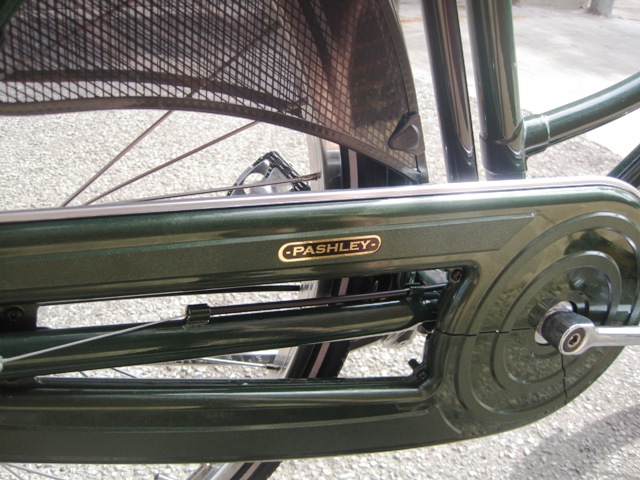
A completely enclosed chain on a Pashley bicycle. Image courtesy of Let's Go Ride A Bike

When dérailleur gears are no-longer used, the possibility of completely enclosing the chain is opened up. A chain guard has the advantage of protecting the rider from the chain, meaning no more trouser clips or rolling up your trouser leg. A chain case offers this advantage whilst also protecting the chain from road filth and rain, leading to a longer life and reduced maintenance.

North Road Handlebars


Most of the bikes on sale in the UK come with either riser or straight bars, as seen on mountain bikes, or drops (resembling ram's horns), as seen on racing bikes. These bars offer a moderately aggressive (straight) or aggressive (drops) riding posture suited to sport cycling. For everyday transportation, they are not the best choice for everyone. North road handlebars (and similar variants) offer an upright riding position. The advantages of this include; comfort for the rider, increased head height (ideal when negotiating traffic) and rider weight is shifted back (reducing the possibility of going over the handlebar under heavy braking).

Steel


A lugged joint between a top-tube and head-tube on a steel frame. Image courtesy of Rivendell

Aluminium has become a very popular frame material in recent years, due to the pursuit of ever lighter bicycles. It is light and stiff, making it an appropriate material for frames. The different properties of aluminium mean that it is desirable to use oversized tubing, which makes the frame particularly light and stiff. Despite this, many feel that steel produces a better quality of ride, the reduced stiffness of the narrower tubing used in forks seems to allow more of the vibration from the road to be absorbed and dissipated before it reaches the rider. This perception is of course completely subjective, but is something worth considering. Other advantages of steel include the possibility of lugged construction, which I find to be aesthetically pleasing, and the relative ease with which a steel frame can be repaired in comparison to an aluminium one.

Relaxed Geometry


I read somewhere that most of the bikes which have ever been manufactured are of the same basic design as the English Roadster or the Dutch Bike. In the UK however, this design in geometry have fallen out of favour. Whilst the roadster is enjoying a bit of a resurgence due to the popularity various models of Pashley Cycles, the relaxed roadster geometry is mainly only seen on bikes marketed as "traditional" or "heritage" bikes. The geometry of these bikes makes them ideal for everyday transport for the average person's needs. In addition to the models make by Pashley, I'd like to see some more designs based on this geometry available in UK bike shops.

Dynamo Lighting


A topic I have written about extensively, dynamo lights are a great option for an everyday transport bike, where an "always available" lighting solution is very desirable. Most people are put off by memories of cheap bottle dynamos driving terrible filament lamps, but modern hub and bottle dynamos are much better. Combine these with modern LED lighting technologies and you have the perfect dependable lighting solution for an everyday transport bike. No batteries, no fuss.

What bicycle components and accessories which have fallen out of favour would you like to see coming back?