I have written previously about the effects of risk compensation on road safety. A good example of this effect is the Munich Taxi experiment, where a fleet of taxis, half with ABS and half without were secretly monitored and the differences examined. It was found:
“Drivers of cabs with ABS made sharper turns in curves, were less accurate in their lane-holding behaviour, proceeded at a shorter forward sight distance, made more poorly adjusted merging manoeuvres and created more "traffic conflicts". This is a technical term for a situation in which one or more traffic participants have to take swift action to avoid a collision with another road user.[3] Finally, as compared with the non-ABS cabs, the ABS cabs were driven faster at one of the four measuring points along the route. All these differences were significant.”
In brief, the increased safety offered to the vehicle operators/occupants by the improved brakes was compensated for by an increase in risk-taking behaviour by the vehicle operators.
I currently operate a “fleet” of three bikes, all of which have different types and combinations of brakes:
The DL-1 has 70 mm Sturmey Archer drum brakes in both the front and rear wheels. These offer reasonable stopping power and supreme durability, requiring almost zero maintenance. Sturmey Archer drums offer good modulation, with light braking being easily controllable and hard braking available if you need it when you really squeeze the levers.


The Sturmey Archer drum brakes; front (top) and rear (bottom)
The Brompton has calliper brakes front and rear. These were presumably chosen because they offer reasonable stopping power and reasonable durability whilst minimising weight (which is an important consideration for a folding bike, unlike a full-sized transport bike). A peculiarity of the Brompton is that the rear brake seems to offer more stopping power than expected, whilst the front feels weaker than expected. The callipers offer similar stopping power and modulation to the Sturmey Archer drum brakes, but are exposed and thus require more maintenance.
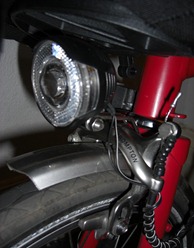

The Brompton calliper brakes; front (left) and rear (right)
The Yuba Mundo has a more exotic brake configuration; a rear V-brake and a front 185 mm Avid Juicy hydraulic disc brake. This combination was chosen because the original front V-brake did not offer what I felt was appropriate stopping power or modulation for a loaded Yuba Mundo. The rear V-brake is adequate; offering a lot of stopping power but poor modulation, with a small amount of brake lever travel the brakes make the transition from doing hardly anything to slow the bike to locking up the rear wheel. The front disc brake offers an extreme level of stopping power, which is ideal when the bike is loaded. It also offers good modulation for when a small amount of braking is required. When the bike is unloaded/lightly loaded, it is able to stop incredibly quickly.
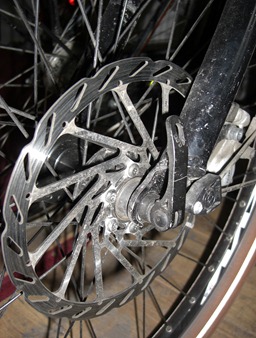

The Yuba Mundo front hydraulic disc brake (top) and rear V-brake (bottom)
Whilst I use all three bikes regularly, I rarely use different bikes in quick succession. A few weeks ago, I returned from a 30 km ride on the Yuba Mundo to pick up some wheel building parts which I dropped off at home. I had to pop back to work immediately afterwards and took the DL-1. When I approached the first set of traffic lights I experienced risk compensation first hand; after riding the lightly-loaded Yuba Mundo over a few hours I had become accustomed to riding faster and braking later for a given set of road conditions, and I had to brake very hard on the DL-1 to stop in a space which the Yuba Mundo would have been able to stop in easily. This is why I worry when I hear about engineering-based safety enhancements such as ABS in cars, they improve the safety of the vehicle’s occupants but this is often at the expense of everyone outside of the vehicle.


