I was stunned this week by some quotes from the Association of British Drivers which were featured in a post from As Easy As Riding A Bike. Whilst the criminal behaviour of motorists being rationalised by a motoring organisation is far from new, I found the sheer unashamed stupidity of what was being said really quite shocking.
"Because speed limits are set below the level at which the majority of drivers consider to be reasonable, you get a very high level of non-compliance. And you get a greater disparity of speeds – you get more frustration, [...] that will result in a large queue of drivers behind, who simply want to drive at what they consider to be normal speeds, and that leads to frustration, dangerous overtaking… "
A responsible drivers' organisation might suggest that a driver who gets so frustrated by having to drive within the law that they might attempt a manoeuvre which not only puts themselves in danger, but endangers the lives of innocent people might be better off not being allowed to drive at all, this is the ABD, and it is not an exaggeration to say that the ABD literally don't know the meaning of the word 'responsibility.' It is interesting to try to apply the ABD's logic to other areas:
Theft:
"Because the definition of theft is are set below the level at which thieves consider to be reasonable, you get a very high level of non-compliance. And you get a greater disparity of theft – you get more frustration, [...] as thieves try not to steal, and that leads to frustration, and when it gets released, events such as the August riots happen… "
Domestic Abuse:
"Because the definition of domestic abuse is are set below the level at which abusive partners consider to be reasonable, you get a very high level of non-compliance. And you get a greater disparity of beating – you get more frustration, [...] as abusive partners try not to beat their partners, and that leads to frustration, and when it gets released, it leads to serious injuries and even deaths… "
Road Safety:
"No, not lower speeds – lower speed limits. Because speed limits are set below the level at which the majority of drivers consider to be reasonable, you get a very high level of non-compliance. And you get a greater disparity of speeds – you get more frustration, because a small minority of drivers will obey the speed limit, even if they think it’s really silly, and that will result in a large queue of drivers behind, who simply want to drive at what they consider to be normal speeds, and that leads to frustration, dangerous overtaking… It also can lead to long queues of traffic, which prevent side road traffic from entering, or crossing, a main road. So you get these additional conflicts, even road rage, as a result. So if you have sensibly-set speed limits, which means set at the 85th percentile, which is the level that 85% of drivers wouldn’t exceed anyway, experience has shown – this goes back, certainly in the United States, to the late 1930s – that is the safest level at which to set speeds, speed limits, and you get the lowest casualty rates."
Oh wait, that one was real. The ABD goes on to use that brilliant debating tactic of pretending that something which is bullshit is actually backed by science (brilliantly debunked later in the original post). Their website actually displays this crap proudly on their homepage, but they have made it even more entertaining to read:
"The ABD calls for the use of sensible speed limits that are based upon well established scientific road safety principles, not political correctness, emotive hysteria, or vociferous local activists."
Ahh yes, that well established scientific principle of 'Be safe: drive as fast as you want, wherever you want.' I really admire the balls they show by calling their made-up science 'well-established.' In fact is it so well established that it goes against everything that every bit of real road safety research and every road safety organisation in the whole world is saying. If that's not well established, I don't know what is! To make this statement of idiocy even more delicious, they included the Daily Mail's favourite phrase, 'political correctness'
(They cleverly use the original meaning of the phrase, which is, 'Stuff what I done don't like').

Friday, 27 January 2012

Monday, 23 January 2012
CEoGB Policy Bash
On the weekend of the 28th of January there will be a meeting to really hammer down CEoGB policy. The agenda for the event can be found on the CEoGB website. If you wish to be involved, please email chair@cycling-embassy.org.uk. It will be a great opportunity to have your say about exactly how the UK's brightest new cycling organisation pursues its ultimate goal of a real return to everyday cycling in the UK.
Personally, I feel that the CEoGB cannot be too specific in setting out what is and is not acceptable when building infrastructure for cyclists. The present guidelines allow for really quite good cycle infrastructure to be built in the UK, however they are too easily open to the kind of abuse which results in useless facilities which do nothing to help cycling at all, merely providing fodder for Facility of the Month. I find it baffling that such dangerous (and functionally useless) facilities exist in the same country in which I once had to take a workplace safety training course in order to use a step-ladder. Providing the DfT with a set of rules for cycle infrastructure where useful, legally-binding minimum infrastructure standards are set based on the speed and volume of motor traffic and where the difference between roads, streets and lanes, along with the measures each of these requires to make cycling viable for normal people, is clearly defined. At the moment, the established norm is that 'people have their place, but the car must come first,' what we need to work towards is the making idea that 'cars have their place, but people must come first' the new norm.
With the new standards being a legally-binding minimum standard, we will need realistic final compliance dates. One potential method would be to have several compliance dates, a compliance date for a minimum functional network of cycle paths along the main roads in the most highly populated cities (London, Manchester, Birmingham, Glasgow etc.) followed by a date for smaller cities and towns and final dates for complete compliance dates. I'd like to see a minimum functional network of cycle routes along main roads as a priority. There's no point in trying to tinker around the edges with sign-posting 'quiet routes' along back-streets as these areas are already less problematic and are the routes people ideally wish to use to get around. The main roads are the currently the biggest problem for cycling and any approach which ignores fixing the problem of main roads in favour of relegating cyclists to often circuitous routes along back-streets sends a message of cycling not being taken seriously as a mode of transport. Such schemes will fail, as they consistently have in the past.
An interesting idea (although one not likely to happen) is to take the scientific approach and do an experiment. Choose a decent number of towns with broadly similar sizes, population densities, employment rates and geography and split them into three groups. In the first group, re-design the road network in-line with the measures used in The Netherlands. In the second group, waste invest the same amount of money on more traditional British approaches to encouraging cycling, 'promote cycling through advertising campaigns, cycle training, handing out lights and high vis, cycle maintenance workshops, building town centre cycle enclosures with lockers and showers and asking motorists to be nicer to cyclists. The third groups would be the control group. In all three groups, modal share amongst all modes of transport would need to be thoroughly monitored, with demographic information also being useful. Run the experiment for ten years and then publish. I think we all know what the results would be, but at least it'd start an 'interesting' thread on Cyclechat.
Interestingly, this central policy of the Cycling Embassy will actually benefit everyone, not just cyclists. Ending the system whereby our streets and roads are effectively ruled by those who are most able to get their own way by (intentionally or otherwise) intimidating other more vulnerable road users comes with huge and obvious benefits which are simply too numerous to mention in the scope of this piece. Needless to say, anyone who is ever a pedestrian, ever rides a bike, is (or may ever be) disabled or elderly, is (or has, may one day have, or was once) a child, owns or works for (or may one day do so) a retail-based business or who pays (or may one day pay) any form of tax in the UK (amongst many, many other groups) has everything to gain from the UK road network being dragged into the 21st century, closely in line with the system used in The Netherlands today.
Put simply, the Dutch system of Sustainable Safety takes the approach that sometimes people can be dicks. Once you accept this, it becomes easily possible to utilise the design of the roads, streets and lanes themselves in order to minimise the harm resulting from this inevitable fact of life. If you want to have your say on the specifics of this infrastructure, or how we go about lobbying for it, the policy bash is your chance to get involved.
Thursday, 19 January 2012
Places for People
I came across this earlier today in Macclesfield. It's nothing out of the ordinary, a van parked illegally, partially on double yellow lines and at the intersection with a minor road, blocking the route for pedestrians and making it less safe when they do try and cross. The sort of thing you might see hundreds of times in a typical week in the UK. What tickled me was the company branding, the van belongs to a company called Places for People.

Wednesday, 18 January 2012
Recurring Themes
Once again we find ourselves in January, and once again I find myself writing about an incident where someone has attempted, without provocation, to use a motor vehicle as a weapon to either intimidate or assault me. Once again, the sole reason behind this appears to be something as innocuous as my choice of transport mode. Once again the driver and occupants of the vehicle were around 17-19 years of age and once again they were exclusively male.
The sad thing is that most regular cyclists have similar stories of unprovoked aggression from motorists. Most regular cyclists I have spoken to have at least one story of a motorist attempting to intimidate them or cause actual bodily harm for no other reason that they had the sheer audacity to choose to get around on a bike.
A significant minority of the general population seem to have the capacity to behave like this. When using public transport or on foot they might be a nuisance to others. On a bicycle they may risk causing injury to others and themselves in the process. In a car, they are able to kill and maim without any risk of coming to harm themselves. Interestingly, the behaviour of this fraction of the general public receives by far the most attention from the mainstream press when they also happen to ride bicycles.
Perhaps it is time to seriously examine the idea of including a thorough psychological examination in the process of licensing drivers. In addition to weeding out those who clearly are not able to behave appropriately when operating a dangerous machine in a public place, it will also help put people off driving in general by increasing the costs and hassle associated with learning and continuing to drive. This can only be a good thing for everyone.
Saturday, 31 December 2011
Farewell 2012 - a Year in Cycling
*The format of this piece is borrowed from David Mitchell's yearly piece in his Guardian/Observer column.
What an eventful year 2012 was in the wide world of cycling. The UK government was forced to adopt the EU fifth motoring pillar as a part of a series of concessions made during negotiating our re-entry into the EU after the events following David Cameron's now infamous use of the UK veto at the end of 2011. The change has yet to have any detectable effect on cycling rates, with a government spokesperson adding, "It seems that the legal technicalities surrounding insurance disputes following road traffic collisions was not the major factor which was keeping people off their bikes. We are at a loss." 2012 was also a year for moral outrage, following from the announcement that Brooks were planning a Soylent variant of their popular B17 saddle. The company to issue a statement apologising for the move, "We misread the market," claimed a Brooks spokesperson, adding "It seems it just isn't the time for this type product right now."
As we are soon to transition from one year into the next, let's take a moment to remember some of the more notable stories from 2012:
As we are soon to transition from one year into the next, let's take a moment to remember some of the more notable stories from 2012:
Churchill Ballad
Earlier this year Adobe released the Re-animation Suite, a collection of software tools which allowed the creation of an animatable CGI model of a person using a combination of archive still and video imagery. Following Adobe's acquisition of Bremneras, a company specialising in voice emulation software, the means to produce photo-realistic animated versions of people which could speak in the appropriate voice were within the grasp of ordinary people. Predictably, many set about using the technology to make crude YouTube videos. However, cycle journalist Carlton Reid seized upon the opportunity to re-animate the speech by Winston Churchill which is used in one of his I Pay Road Tax graphics:
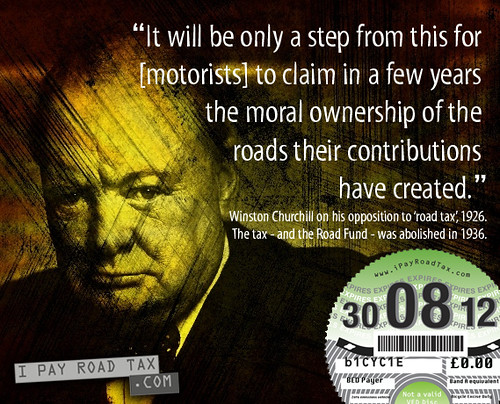
The resulting video was later re-mixed and auto-tuned into a faux-power ballad and promptly went viral. In the process, Mr Reid, creator of the original video, became a mainstream celebrity on the back of the popularity of the viral hit. Carlton's new-found fame led to him being invited as a guest on Top Gear, leading to one of the most memorably violent interviews in the show's run. He also managed to get the fastest time in the reasonably priced car.
Healing Power of Helmets
In August, ground-breaking work was published in the Lancet identifying the possible use of cycle helmets as a powerful universal placebo. Professor got the idea for the study after seeing how strong many non-cyclists faith in cycle helmets was, despite the lack of evidence in support of this position, "I often receive comments and heckles when out on my bike. One of the recurring comments was along the lies of, 'You should wear a helmet, otherwise you'll have an accident.' it was at this point that I realised that the cycle helmet held a special place in the imagination of a large section of the public, who attributed it with almost limitless healing and protective power" This prompted the Professor to put his lab to work in investigating this effect further. Whilst the helmets could not do much to help cyclists in the event of a crash, the group found that wearing a helmet during the recovery process significantly reduced treatment time compared to the control group. The team proposed that what they were witnessing was actually a super-powered variant of the placebo effect, noting that helmets could be used to reduce recovery times for illnesses and injuries which were completely unrelated to cycling.
Cycle helmets are now used as a universal placebo in hospitals nationwide, shortening the recovery times for all patients regardless of their condition. Whilst the work has been widely welcomed, it has been a disaster for Cyclehelmets.org, who now have to issue a warning to visitors of their site that the contents may prevent their future use of the universal placebo treatment. Those who choose to continue reading the site are urged to carry a card stating that in the event of injury, use of the new universal placebo will no longer be effective.
Cat-6 Olympic Shocker
Earlier in the year, there was a great deal of surprise when the IOC unexpectedly recognised Cat-6 racing as a separate Olympic sport. The inaugural race taking place at the London 2012 games. As I'm sure most of you are aware, professional Cat-6 racing takes place on open streets and the winner does not merely cross the finish line first, but must be acceptably presentable for a working typical office environment. The sport attracted athletes from other cycling disciplines who were keen to be the first to win gold in the new event, in addition to enthusiastic amateurs including Mr Jim Davis from The Cycling Embassy of Great Britain. Whilst Mr Davis (who rode his Dutch bike during the event) crossed the finish line last, he was already dressed in a suit and didn't need to take a shower. To the shock of much of the world of professional cycling, he took home the gold medal.
In the months since the games, the recognition of Cat-6 racing as an Olympic sport and the result from the first race has had a profound result on the nation's Fred population. Many manufacturers were quick to respond, with Specialized producing an all-crabon roadster including crabon mudguards and chaincase and Endura produced a Cat-6 cycling suit which is designed to be indistinguishable from a regular £150 suit in every single characteristic (MSRP £350). Sturmey Archer announced that crabon-shell version of their popular AW hub will go on sale in early 2013, complete with all-titanium internals.
Trek was not so quick to respond, with their new Cat-6 Madone rumoured to just be a Batavus with 'Madone' written on in Tippex.
Trek was not so quick to respond, with their new Cat-6 Madone rumoured to just be a Batavus with 'Madone' written on in Tippex.
Monday, 19 December 2011
Cycling is Safe
This one has been languishing in my drafts for quite some time, with both Vole O'Speed and As Easy As Riding A Bike sharing their own views on the issue in the meantime. Statistically speaking, cycling here in the UK appears to be surprisingly safe. Indeed, in the past I have focussed on this when talking to new and potential cyclists about their experiences of poor subjective safety. These statistics are also readily utilised by a vocal minority who are ideologically opposed to the use of separation by mode for the prioritisation and protection of cyclists. As is often the case with statistics they only tell part of the story; whilst it appears at first that they show cycling to be a 'low-risk activity,' what they literally show is that the current sub-section of the population who choose to cycle are doing so relatively safely.
Like most other people who choose to cycle in the UK, when I cycle I do so in a hyper-aware state; I always expect the worst from other road users, I pre-emptively hover over the brakes when I see a car approaching a give-way line where I have clear priority and I plan my escape route for when that BMW makes a sudden turn without indicating. I am relatively fit, fast, I cycle in the optimal gear and I know precisely how much force I can put into the brakes before the wheel locks up. Put simply, the bar it set much higher for cyclists than it is for other road users because the road environment is inherently hostile for cycling. Most people who drive motorised vehicles, which are significantly wider, faster and heavier than bicycles, do not do so in a similar state of hyper-awareness. This is because there is simply no need; the vehicles and road environment have been designed in such a way that their operators are largely protected from the limitations of their own ability. The bar has been set rather too low for such inherently dangerous machines.
I have often thought that if some of the greatest minds of the 1950s were put together in a room and given and nearly unlimited budget and the specific task of designing a road network to minimise the number of people choosing to cycle, without being permitted to explicitly make cycling illegal, the result would not be far off the current UK road network. The exceptional hostility for cycling which is designed into the UK road network is enough to prevent the vast majority of people from every wanting to cycle on it. The result is that those few who are willing to cycle on it are not at all representative of the general population; it is because this minority can cope with the road network as it currently exists that cycling appears to be a statistically safe activity.
In The Netherlands, cycling is statistically slightly safer than the UK. The difference is not as much as might be expected, which is often used as an excuse for opposing the construction of Netherlands-style dedicated cycle infrastructure in the UK. However, with a little context the safety statistics from The Netherlands start to appear much more impressive. By implementing road designs which are not inherently hostile to cycling, the section of the population choosing to cycle is much more representative of society as a whole. The majority of ordinary people, cycling without being in a hyper-aware state typical of UK cyclists manage to get around by bike and are still statistically more safe than the tiny minority of physically and mentally exceptional UK citizens who choose the bicycle. Next time there is a discussion about how safe cycling is, remember that in places such as the UK where cyclists are a tiny minority, the statistics don't tell you a great deal about how safe cycling is, only how safe cyclists are.
Tuesday, 13 December 2011
The Twelve Days of Christmas
Apologies for my recent absence, unfortunately the blog had to go on the back-burner for a few weeks. It is now less than two weeks to Christmas, which means I can share with you The Twelve Days of Christmas (for cyclists) starting on the last verse. Feel free to sing along.
On the Twelfth day of Christmas my council gave to me
Twelve Cyclists Dismounts

Courtesy of Facility of the Month
Eleven-inch wide bike lanes

Courtesy of Facility of the Month
Ten side-road give-ways

Courtesy of Facility of the Month
Nine wheel-benders

Courtesy of Facility of the Month
Eight near misses

Courtesy of MiddleAgeCyclist
Seven narrow 'A' frames

Image courtesy of Mad Cycle Lanes of Manchester
Six-Pounds from the budget

Check out At War with the Motorist
Five buckled rims

Image courtesy of Bakfiets en Meer
Four biking 'crackdowns'

Image courtesy of Bike Snob NYC
Free high-vis

Image courtesy of The Lo Fidelity Bicycle Club
Two ASLs

Image courtesy of Crap Cycling & Walking in Waltham Forest (RIP)
And a bike lane running through a tree

Image courtesy of Facility of the Month
Subscribe to:
Posts (Atom)